- The caste of Nobles (aristocracy, military leaders and shamans) – their skin is pale, their fingers are long, their hair is blonde, their eyes are piercing, they are wise, understand the language of birds, know the runes, and the spells associated with them; the men are skilled at using weapons, horse-riding, hunting, swimming and war – causing them to own large estates and treasure, with which they are generous; couples love each other deeply and their children have names such as Noble, Kinsman, Heir and King.
- The caste of Freemen (landholding farmers, artisans and soldiers) – they are skilled and industrious workers, eg, the men are skilled at wood carving, working the plough, and building wagons, barns and homes, while the women engage in wool-spinning and weaving; their hair is tidy and they wear nicely tailored clothes; they are married (they've “exchanged rings”) and their children are described as red-haired and keen-eyed; their sons have names like Manly, Brave, Swordsman, Soldier, Smith, Farmer and Trim-beard, while their daughters have names such as Sensible, Smart, Swan, Lady, Shy and Vivacious.
21 October 2022
The Heimdall Caste System in Germanic Polytheism
25 September 2022
Interpreting the Gohonzon (Buddhist Object of Veneration)
The object of veneration in Nichiren Buddhism is the Gohonzon, a sacred mandala which practitioners are encouraged to chant in front of twice a day. Nichiren Buddhism originated in Japan in the 13th century and is now practised worldwide, particularly (when outside of Japan) by members of the Soka Gakkai International (SGI). Members of the SGI receive a Gohonzon when they join the organisation. They then enshrine the Gohonzon in a Butsudan (a small cabinet for housing sacred objects) in their homes.
The images on the Gohonzon consist of beautiful Chinese-Japanese calligraphy representing many things, including important deities. Most of the Gods on the Gohonzon refer to ancient Indian Gods, thus in attempting to understand the nature of these deities I have looked to their Roman equivalents. Given that these deities have a shared Indo-European origin this approach seems suitably viable. Using the interpretatio Romana the major deities represented include Dis Pater (top left), Neptune (top right), Venus / Cupid (centre left), Aurora, Diana, Jupiter, Apollo, (middle centre), Vulcan (centre right), Juno (just below the middle), Ceres (lower left), Mars (left of the lower middle), and Mercury (lower right).
18 February 2022
Neo Feudalism
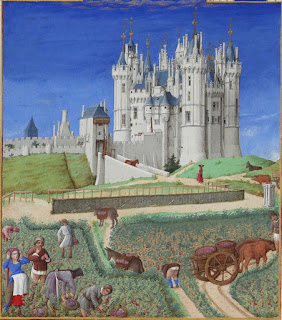
| Castle of the Duc de Berry by the Limbourg Bros (15th c.) |
There is an idea that has emerged in recent years which holds that Western nations are increasingly dominated by billionaire elites and multinational corporations who seek to transform our nations into authoritarian surveillance states, wherein censorship is widespread and widely tolerated, real property is so hideously expensive that large portions of the population never even try to acquire it, and so many people live in what feels like a profaned world devoid of spiritual aspiration that nihilism is commonplace. On the other hand, a smorgasbord of transitory pleasures (junk food, online games, porn, prescription meds, etc) is perpetually within reach. Perhaps Tacitus’ observations about the actions of the Governor of Roman Britain in the 1st century CE are germane:
“Agricola … described his campaign … as ‘keeping a conquered people under control’ … His intention was … [that the native Britons] become accustomed to peace and quiet by the provisions of amenities. Hence he gave … assistance to communities to build temples, market-places, and town houses. He praised those that responded promptly [to Romanisation] and censured the dilatory. As a result they began to compete with one another for his approval, instead of having to be compelled … even our style of dress came into favour and the toga was everywhere to be seen. Gradually, too, they went astray into the allurements of evil ways, colonnades and warm baths and elegant banquets. The Britons … called it ‘civilisation’, although it was a part of their enslavement [Tacitus, Agricola and Germany, Oxford World’s Classics, Ch 18-21].”
Could it be that we are at risk of succumbing to the illusion of good living while in fact being profoundly unfree? In order to explore the possible answer to this question one first needs to understand what bondage actually is, hence the following exploration of some forms of servitude that have historically existed within European societies
Subscribe to:
Comments (Atom)
