Showing posts with label History. Show all posts

12 April 2026

Olga the Varangian

A Varangian reenactment in 2019. Image source: Silar
In the 10th century Olga was married to Igor, Prince of the Rus, who at this time were Pagan. The origin of the Rus is disputed, though the most widely accepted view is that the Rus rulers were originally Scandinavians (mostly from eastern Sweden), also known as Varangians, who came to rule over Slavs in what is now NW Russia, and then over generations interbred and assimilated so as to became fully Slavic. The first Rus ruler, in the 9th century CE, was Prince Rurik, who was succeeded by his kinsman Oleg, who conquered Kiev in 882 CE, as well as much other territory. Oleg attacked Constantinople in 907, forcing the Byzantines to sue for peace in exchange for payment of a large sum. In 911 Oleg negotiated a favourable trade agreement with Constantinople, but died shortly after.

Oleg was succeeded by Igor in 912, who expanded Rus rule over the Pechenegs (a Turkic people) and the Drevlians (a Slavic people), and led expeditions against the Byzantines in the 940s, which failed due to the destruction of his ships by legendary “Greek fire”. Olga gave birth to Igor’s son Sviatoslav around this time. Igor was murdered by the Drevlians in 945, while collecting tribute. At this time Sviatoslav, Igor’s heir, was very young.

14 October 2024

Ancient Roman Christians

Christian beliefs and practices in the 2nd and 3rd centuries


Icon of Mary, Rome (6th century or earlier)
Image source: Asia
Given that I have a good understanding of the religious landscape in ancient Rome it seems fitting to look at Christianity during this era. Many contemporary analyses of this kind focuses heavily on the New Testament, with a particular focus on 1st century Christians. As there is nothing I can add to the discussion on 1st century Christians I am instead starting in the 2nd century, with a focus on this nascent religion as it was before it became a major political force in the 4th century CE.

“Within a short time after Christ’s death [certainly by the 2nd century], Christianity became identified as a cult quite separate and distinct from Judaism. Non-Jewish converts often brought to the new cult ideas and rhetoric from their former religions or philosophies [especially Stoicism and Neo-Platonism] … Christianity … was a cult that attracted large numbers of lower-class people and encouraged them to participate in … emotionalism ... [and] private assembly ... [Shelton at 407-409]”

In the early 2nd century a Roman governor wrote to Trajan (ruled 98-117 CE) about the measures he was taking in relation to adherents of the new religion:

18 February 2022

Neo Feudalism

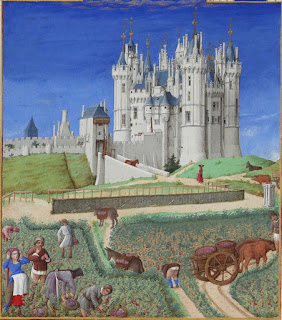
Castle of the Duc de Berry by the Limbourg Bros (15th c.)
Sometimes I wonder if I am, in reality, a tax-serf and this point in history marks the beginning of neo-feudalism or techno-feudalism. 

There is an idea that has emerged in recent years which holds that Western nations are increasingly dominated by billionaire elites and multinational corporations who seek to transform our nations into authoritarian surveillance states, wherein censorship is widespread and widely tolerated, real property is so hideously expensive that large portions of the population never even try to acquire it, and so many people live in what feels like a profaned world devoid of spiritual aspiration that nihilism is commonplace. On the other hand, a smorgasbord of transitory pleasures (junk food, online games, porn, prescription meds, etc) is perpetually within reach. Perhaps Tacitus’ observations about the actions of the Governor of Roman Britain in the 1st century CE are germane:
“Agricola … described his campaign … as ‘keeping a conquered people under control’ … His intention was … [that the native Britons] become accustomed to peace and quiet by the provisions of amenities. Hence he gave … assistance to communities to build temples, market-places, and town houses. He praised those that responded promptly [to Romanisation] and censured the dilatory. As a result they began to compete with one another for his approval, instead of having to be compelled … even our style of dress came into favour and the toga was everywhere to be seen. Gradually, too, they went astray into the allurements of evil ways, colonnades and warm baths and elegant banquets. The Britons … called it ‘civilisation’, although it was a part of their enslavement [Tacitus, Agricola and Germany, Oxford World’s Classics, Ch 18-21].”
Could it be that we are at risk of succumbing to the illusion of good living while in fact being profoundly unfree? In order to explore the possible answer to this question one first needs to understand what bondage actually is, hence the following exploration of some forms of servitude that have historically existed within European societies

21 December 2020

The Ancestral Diet of the Germanic People

"Julaftonen" by Carl Larsson (1904)
As creatures of evolution we should ideally be consuming a diet consistent with our human biology, which arguably means looking at what our ancestors ate. As someone with predominately Germanic heritage (plus a little bit of Celt) I want to take a look at as many reputable sources as I can to understand what the indigenous diet of the Germanic people is, noting that it will overlap a good deal with the indigenous diet of other Indo-European peoples. 

Before humanity 
Humans are primates belonging to the subgroup known as great apes. Primates are believed to have evolved around 65 million years ago, following the mass extinction event which brought an end to the age of dinosaurs. Apes evolved around 25 million years ago, mostly or exclusively in heavily forested environments. Our primate cousins – monkeys and lesser apes – never really left their homes in the branches and tend to eat mostly leaves and fruit. Other great apes are still animals of the forest but they are bigger and able to roam forest floors. At least 87% of their diet is plant based (especially fruit), supplemented by insects. Chimpanzees, our closest relative, also eat meat. Our lineage separated from the chimpanzee line around 7 million years ago, so it is likely our ancestors have been eating meat (and other parts of animals, such as organs and bone marrow) for millions of years – ie, long before we evolved into modern humans. 

06 March 2020

Pax and the Roman Understanding of Peace

3rd century denarius depicting Pax 
(moneymuseum.com)
The worship of the Goddess Pax (Peace) in ancient Rome first comes to prominence during the reign of Augustus, when in 13 BCE the Senate commissioned the Ara Pacis Augustae (Altar of the Augustan Peace) to mark the safe return of Augustus from Gaul and Spain. Significantly, it was dedicated on the Campus Martius (field of Mars), which until the 1st century BCE had been used primarily as a military exercise ground. This is a powerful hint as to how ancient Romans understood Pax, ie, that Pax and Mars have a relationship with each other. In the Roman mind, Mars (war) establishes the necessary conditions for Pax (peace) to flourish.

01 June 2019

The Greco-Roman Cosmos

Illustration from La Sphere du Monde by Oronce Fine (1549)
(the sublunary elements are fire, air, water and earth; above the moon is aether)
In most ancient Greek and Roman minds the distant stars were not thought to be suns capable of supporting a family of orbiting planets, and our own sun was not thought to be the central hearth-fire of our familial solar system. Their view of the cosmos was fundamentally different to our own.
“The Greeks, by about 500 BC, were trying to explain the movements of the planets by first assuming the earth to be the centre of the universe. ( … practically everyone before modern times assumed that it was.) A philosopher named Anaximenes about 550 BC suggested that the stars were fixed in a huge hollow sphere that enclosed the earth, the sun, the moon and the planets … This sphere might be motionless while the earth turned, or vice versa. Later Greeks argued both ways. 
The sun, moon and planets could not be fixed to this sphere of the stars, because they did not move along with the stars at the same speed. They must therefore exist in space between the sphere of the stars and the central earth … each must be fixed in a special sphere of its own [Asimov at 25-27].”

11 October 2015

The Religion of the Rus – Viking Heathens

Artist: Vsevolod Ivanov. Source: renegadetribune.com
In the early 10th century a devout Muslim diplomat was sent by the powerful Abbasid Caliph to teach the intricacies of Islam to a king of the Volga Bulghars, deep inside Russia, who had recently converted – possibly so he could enlist the help of the Caliphate in his struggles to defend his kingdom against the nearby Khazars. This Arab traveller is now commonly known as Ibn Fadlan and he has become famous for his account of the polytheistic peoples he encountered on his journey, especially the Turks and the Rus – both peoples would, respectively, become Islamic and Christian within a century or so of his account. The Rus were (most scholars believe) originally Vikings who, over a roughly 200 year period, assimilated with the Slavs of Russia and gave their name to that great nation. The 12th century Russian Primary Chronicle is the primary source for this assertion. We also have corroborating evidence from, inter alia, another Muslim called Ibn Rustah, a Persian scholar who authored an encyclopedia that was completed in 913 – his entry relating to the Rus is thought to derive from an anonymous source dating from the 860s, and in it he seems to suggest the Rus and the Slavs are distinct from each other when he writes:

07 March 2015

The Nicholson Museum

In the mid to late 19th century many educated British men and women were obsessed with ancient Greece and Rome. Adventurous British people of this era often found themselves in the colonies, including New South Wales, Australia. One of these fellows was Sir Charles Nicholson, who was a founder of the University of Sydney, which is now the oldest Australian university. The university was founded in 1850; seven years later Nicholson travelled to Europe, inter alia, to do a grand tour of Italy, Greece and Turkey and buy antiquities for what became, in 1860, the university's Nicholson Museum.

06 April 2014

Venus in Art

There are dozens, if not hundreds, of images of Venus which have survived from ancient times. Many of them are curvaceous, in fact some ancient Roman Venus' are even a little plump, and there are many that are slim, but they are never too skinny, for how could Venus look as if she starves herself when she is a Goddess of life and fertility? Neither have I seen any depictions of Venus as obese. Likewise, for most artists since the renaissance Venus has been celebrated as looking like a woman with a healthy body, neither skeletal nor grotesquely overweight. Here follows a celebration of the many portrayals of Venus over the centuries.

25 January 2014

Alma-Tadema - Roman Visions

Victorian Britain (1837-1901) was more than a little obsessed with the Roman era - from their Queen, who was named after the Roman Goddess of Victory, to the expanding British empire which bore similarities to that of Rome's, to the copious number of Romanesque artworks produced in the United Kingdom during that time. Of all the painters dealing with Roman themes none was more popular than Dutch-born Sir Lawrence Alma-Tadema (1836-1912) - a prolific painter who specialised in depicting (somewhat romanticised) scenes of everyday life in the classical world. While some of his work seems a little kitsch these days, some of it is wonderfully evocative and brings the ancient world to life. In homage to this true Romanophile, here follows some of my favourite Roman-themed works by Alma-Tadema.

04 August 2013

Y-DNA Haplogroups of Europe


Child of the Indo-Europeans tribes? Actress Ivana Baquero is from Catalonia
(Spain) where haplogroup R1b is represented by over 80% of men
Last week I discovered what Y-DNA haplogroups are and I was fascinated, for they represent the most reliable analysis of the genetic make up of nations that science has offered to date. Being a child of Europe I was most interested to learn about the ethnic/genetic make up of people from this region (excluding post WW2 immigrants). As I did I was surprised, amused and somewhat discomfited to learn that there really is no such thing as ethnic purity and just about everyone is related to everyone else – and not just in Europe. I also realised that the pride I have felt regarding my Indo-European ancestors (probably represented by haplogroups R1a and R1b) should perhaps be balanced with an acceptance that the Indo-Europeans encroached on lands traditionally belonging to the “native” inhabitants of Europe (represented by haplogroup I) – who did not die out, but interbred with their possible conquerors – and who are also almost certainly my ancestors. Then there is the real possibility that I have some ancestors belonging to various other haplogroups with diverse origins, such as J2 and G2 (west Asian), N1C1 (north Asian) and E1b1b (north African) – which are found across European populations.

08 March 2013

The Golden Ass and the Catamite


Patera depicting Cybele and Attis, 4th century CE, source: ancientrome.ru
As the traditional time to mourn and then celebrate the death and resurrection of Cybele's beloved Attis draws near there is perhaps no better time to look at the role of the galli in ancient Rome. The galli were priests of the great Goddess Cybele, also called the Magna Mater. In imitation of her lover, Attis, who was said to have castrated himself after being driven into a frenzy by a jealous Cybele, the galli castrated themselves during the festival of Attis. Thereafter these “mad eunuch priests” (to quote Lucretius) dressed in women’s clothing, which were typically brightly coloured, wore earrings and heavy make up, and became well known for their wild rites in which they ritualistically flogged and mutilated themselves whilst in an ecstatic frenzy brought on by boisterous music and dancing. They were also well known fortune tellers and were perhaps the only priests permitted to beg during the Roman era.

02 November 2012

Julian the Apostate – Pagan Hero?

Bust of Julian (4th century): St Petersburg
When I first heard about Julian the apostate (also known as J
ulian the philosopher)  the last polytheistic emperor of Rome, who attempted to reinvigorate the old ways throughout the Roman Empire after decades of Christian rule  I was naturally pretty interested. My initial impression was that he must of been amongst the last of the old school Romans bravely trying to push back the tide of Christianity. As I have learned more about him, and his times, I have come to realise that this was a naïve and self-serving perspective. I know now that Julian the apostate was an infinitely more complex character than I could have ever imagined and perhaps, ultimately, an unknowable one at that.

The first thing to know about Julian the apostate is that he was indeed a Christian apostate – he was not brought up as a Pagan. He was raised as a Christian. From the age of seven he was under the guardianship of the Bishop of Nicomedia (having been orphaned by his murderous cousin, the emperor Constantius II) and he later became a lector of the Christian church. It is known that he had a detailed knowledge of Christian teachings and it is thus an inevitable conclusion that Julian’s world views were profoundly influenced by his Christian education. The monotheism that earmarks Christian teachings appeared to have stayed with him, to some extent, as he drew ever more interest in classical philosophy and Hellenic polytheism.

03 June 2012

The Roman Structure Within Faversham Stone Chapel


Roman brickwork within Faversham Stone Chapel
In a field in Kent the ruins of an ancient building of uncertain origin lies. It is called Faversham Stone Chapel, or alternately Stone-next-Faversham, and was known as the Church of Our Lady of Elverton – or Our Lady of Elwarton – from the 7th century until the 16th century, when it was abandoned after falling into a state of disrepair. The building was not, however, forgotten. From the 18th century onwards it became the occasional subject of archeological interest because it was clear that this was no ordinary church for, as Hasted pointed out in 1798, within the ruins of the Stone Chapel there are: