A little while ago I was at a pub and noticed an amazing tattoo of the Egypto-Roman Goddess Isis underneath the shirt of the man across from me – I was super impressed and we got talking … turned out he got the tattoo because he just thought it was a cool design; wasn’t a Pagan at all. Although, strangely, he did claim to have been a gigolo when he was younger. I have no idea if this was true but I did later hear a story (apparently true) that he fell in love with a woman who lived overseas and he packed a suitcase full of lube, condoms and Viagra when he went to visit her – an old trick of the trade perhaps?
That story is a diversion, but it was his tattoo that got me thinking about Pagan tattoos and how cool they can (potentially) be. There are some awesome tattoos dealing with the Greco-Roman pantheon out there – here are some of the best that I was able to find online (note that some of them were perhaps not originally intended to pertain to a particular deity but I think are evocative of certain Gods nonetheless).
Apollo Apollo is the God of light and the sun, healing (and disease), music, poetry, archery and prophecy.
 |
| Source: tattoopaulski.com |
BacchusBacchus is the God of wine, the vine, libations, liberty, masculine fertility, intoxication and madness.
 |
| Source: inkah.tumblr.com |
Castor and PolluxCastor and Pollux are the twin Gods of camaraderie and strong friendship, particularly the kind forged in war; commonly associated with sailors, thus also sailing and travelling.
 |
| Source: witchcityink.com |
CeresCeres is the Goddess of agriculture, plant growth and crop fertility.
 |
| Source: fyeahtattoos.com |
Diana Diana is the chaste Goddess of the hunt, animals (esp. wild), woodlands, childbirth and the moon.
 |
| Source: sanjosedecalasanzdeduitama.edu.co |
FaunusFaunus is a God of the earth who brings fertility to fields and flocks.
 |
| Source: tatuajesxd.com |
FloraFlora is the Goddess of flowering plants; associated with spring, fertility and sexual licentiousness.
 |
| Source: pinterest.com/sunloverholiday |
Fortuna
Fortuna is the Goddess of increasing prosperity, good fortune, ill fortune, chance and luck.
 |
| Source: flickriver.com/photos/mezdeathhead |
HerculesHercules is a God of heroism, masculine strength and perseverance.
 |
| Source: tumblr.com |
IsisIsis is a Goddess of fertility, healing and compassion. Her cult was wildly popular in ancient Rome.
 |
| Source: pinterest.com |
JanusJanus is the God of beginnings, transitions, openings, closings and entrance-ways.
 |
| Source: kingsavenuetattoo.com |
JunoJuno is the Goddess of women, marriage and motherhood.
 |
| Source: girlfashn2013.blogspot.com |
JupiterJupiter is the protecting God of the sky and weather, especially thunder, lightning, rain and storms.
 |
| Source: forbiddenimages.com |
Magna MaterMagna Mater (Cybele) is the great earth mother of the Gods and all beings.
 |
| Source: tattoogathering.com |
Mars Mars is the God of violence, war, masculine valour and virility.
 |
| Source: rattatattoo.com |
MercuryMercury is the God of financial gain, trade, travel, language, communication, cunning and psychopomp.
 |
| Source: meatshop-tattoo.deviantart.com |
Minerva is the Goddess of skilled thought and skilled action, thus wisdom, workmanship and strategy.
 |
| Source: juncha.net |
NeptuneNeptune is the God of water, the sea and horses.
 |
| Source: nezunoban.tumblr.com |
PlutoDis Pater (also known as Pluto or Hades) is the God of death, the underworld and mineral wealth.
 |
| Source: ratemyink.com |
ProserpinaProserpina is a Goddess of death, of renewal, and of spring. She is the consort of Pluto.
 |
| Source: lineandshade.tumblr.com |
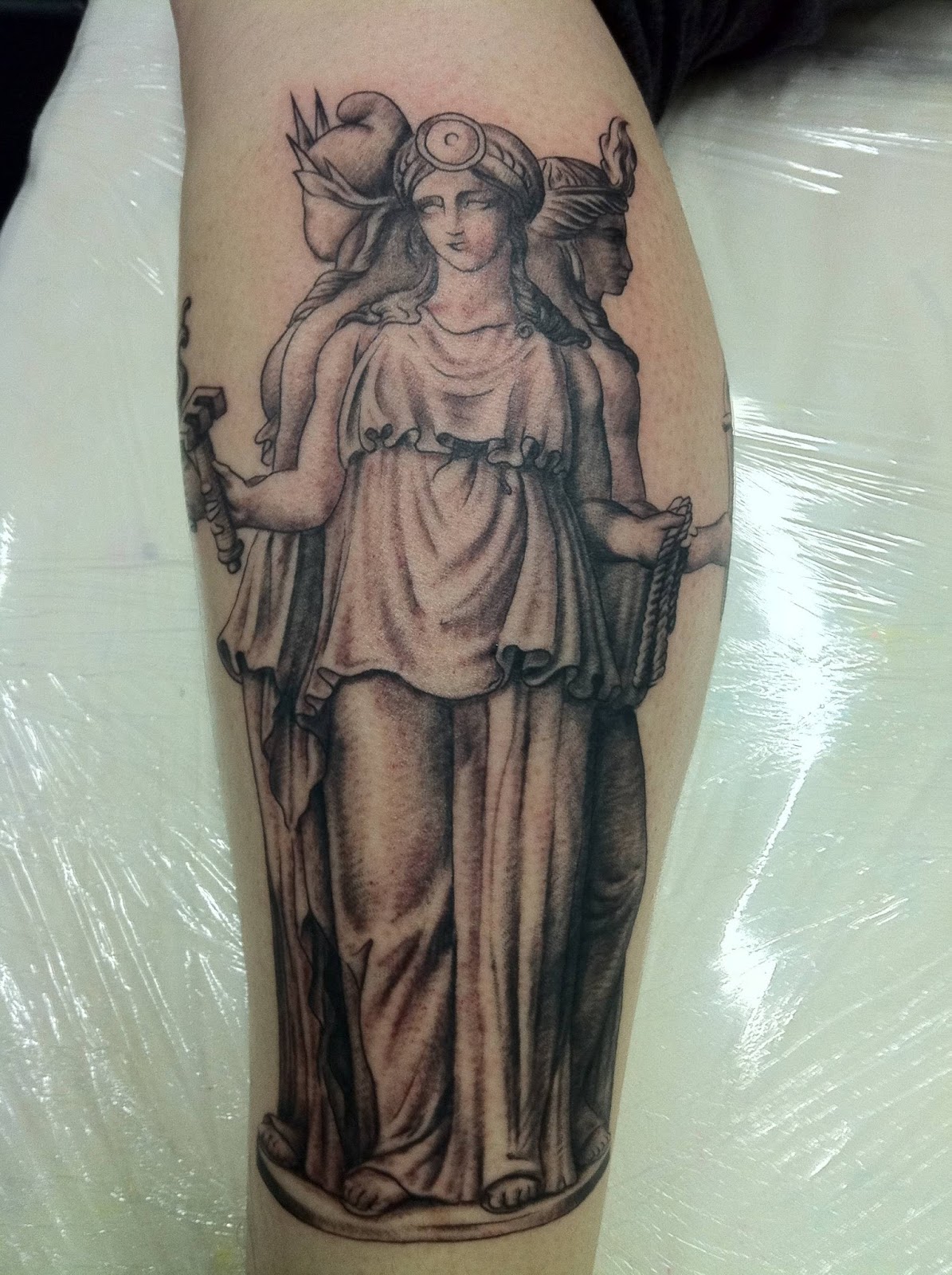
TriviaTrivia (also known as Hecate) is the Goddess of the crossroads, ghosts, the undead and witchcraft.
 |
| Source: flickr.com |
Venus Venus is the Goddess of love, relationships, passion, pleasure, beauty, charm and fertility.
 |
| Source: fotolog.com |
Vesta Vesta is the Goddess of ritual fire, hearth-fire and home; associated with purity and virginity.
 |
| Source: sarapurr.wordpress.com |
Victoria Victoria is the Goddess of victory, especially military victory.
 |
| Source: checkoutmyink.com |
VulcanVulcan is the God of potent (and destructive) fire, the forge and blacksmithing.
 |
| Source: checkoutmyink.com |
As for tattoos in ancient Greece and Rome ... well, as in our own times, they were not generally embraced by the conservative elite, who tended to frown upon them as either a mark of barbarism or ignominy (eg, because slaves and criminals were often tattooed). However, it is clear that decorative tattoos were common in many provincial regions of the Roman Empire (such as Thrace, Dacia, Gaul and Britannia) and among some soldiers too, if not others. So while the very word for tattoo in Greek and Latin is stigma (literally) – that doesn't mean that ordinary ancient people didn't dig tattoos, it just means that in ancient Europe tattoos were ... edgy.
"amongst the Greeks and Romans, the use of tattoos ... seems to have been largely used as a means to mark someone as "belonging" either to a religious sect or to an owner in the case of slaves or even as a punitive measure to mark them as criminals. It is therefore quite intriguing that ... when a dynasty of Macedonian Greek monarchs ruled Egypt, the pharaoh himself, Ptolemy IV (221-205 B.C.), was said to have been tattooed with ivy leaves to symbolize his devotion to Dionysus, Greek god of wine and the patron deity of the royal house at that time. The fashion was also adopted by Roman soldiers and spread across the Roman Empire until the emergence of Christianity, when tattoos were ... banned [smithsonianmag.com]."
For a great article looking at tattoos in ancient Greece and Rome see Adrienne Mayor, "People Illustrated: Tattoos in Antiquity" (1999) 54-57 Archeology 54.




Did you know that Pagan tattoo designs may encompass a wide range of world religions' tenets? Yes! There are many pagan themes, such as veneration of nature and animals, zodiac beliefs, Wiccan religion, or worship of the sun and moon. Additionally, you may use dual symbolism including horned god and triple goddess into pagan tattoo designs, as well as totems like the moon, symbols, runes, and pentacles. I can suggest https://wannabeink.com/products/classic-roman-gods-and-goddesses-etched-in-stone-temporary-sleeve-tattoos to people since I have had a lot of positive feedback from their customers.
ReplyDelete