16 August 2024

Protestant Christianity Versus Christianity

Destruction of "Idols" by Protestants (1524)
I have found myself in an awkward spiritual spot. Years ago I thoughtfully rejected Christianity – I even wrote a blogpost in 2013 about my reasons why. But lately a trinity of events have occurred such that I feel compelled to reconsider my position.

First, a good friend persuaded me to look at a particular window at St Mary’s Cathedral (Sydney) for the aesthetics. It showed Mary on a crescent moon with a halo of stars. It was beautiful and as I looked at it I had a strange sense of a medieval and mystical version of Christianity, and a thought “what a shame this type of Christianity no longer exists”.

Second, my approach to religion subtly shifted over a period of many months until I arrived at a position where I was starting to think maybe God exists in some great cosmic sense, and that the Gohonzon (the sacred mandala of Nichiren Buddhism, which I have been venerating for a number of years) is a portrait of God, and that (at least some of) the benevolent Gods might be God’s helpers.

Third, I listened to a podcast on Martin Luther and had a thunderstruck moment when I realised that the religion I had so thoughtfully rejected a long time ago was perhaps not Christianity but something rather more specific – Protestant Christianity, which is quite honestly just the predominant Germanic take on Christianity from the early modern period onwards. In my mind Protestantism was Christianity and vice versa, simply because I didn’t know any other type. The Christianity I thought I knew was rather uninteresting and uninspiring so it never occurred to me to explore any variations of it. Nearly 500 years of Protestant ancestry had taught me to look somewhat askance at Roman Catholicism, thus I tended to avoid it. My very limited encounters with Orthodox Christianity suggested it was a religion inextricably tied up with ethnic and cultural identities that had nothing to do with me, so I never thought about it, other than to admire the aesthetic. I did not even know there was a church further to the east than Lebanon until a few months ago, such was my general disinterest in Christianity.

The notions I had thought were synonymous with Christianity but are actually features of Protestantism (mostly inspired by Martin Luther and then John Calvin) include:

07 April 2024

Northern European Food Curse – Salicylate Sensitivity

"Kitchen Scene" by van Rijck (17th century)
There is a well-known trope about British people having the runs after a night eating curry. One of the reasons for this, at least for some, is salicylate sensitivity – a heritable food intolerance that many people know nothing about, though it is estimated to affect perhaps around 2.5% of Europeans. An allergy specialist I saw years ago described the phenomenon as “edge of the world syndrome”, she told me that on some days every person in her waiting room with food sensitivities was red-haired, and explained that many people with northern European ancestry are today eating a diet that is utterly alien to that of their ancestors. Basically, northern Europeans adapted to eating a diet that was, for the most part, naturally low in salicylates. In so doing some of them lost the ability to efficiently metabolise the higher amounts of salicylates naturally found in the skin of most fruit, herbs and spices (as well as many vegetables) found further south on the globe – foods that are becoming increasingly common in modern Western diets. Today, many people put up with the symptoms of salicylate sensitivity because the symptoms are either mild enough to ignore or because they don’t understand the root cause of troubling health issues. 

15 September 2023

The Hyperboreans and Their Connection with Apollo

Apple Tree in Blossom by Larsson (before 1919)
In the 5th century BCE Herodotus wrote of the Hyperboreans, a word which literally means “over Boreas”. Boreas is the Hellenic God of the north wind, sometimes conceived of as living in Thrace, which is more or less the land we now call Bulgaria. Herodotus described the Hyperboreans thus:

“A man of Proconnesus [a Greek town in modern day NW Turkey], one Aristeas … came to the Issedones [ancient people who lived in central Asia] and, being inspired by Apollo, wrote a poem in which he declared that above the Issedones there lived a tribe of Arimaspians, being men with one eye, and, above these, the griffins [birds sacred to Apollo] that guard the gold, and, above these, the Hyperboreans, whose land reaches to the sea. All of these people, beginning with the Arimaspians and excepting only the Hyperboreans, continually make war upon their neighbours. The Issedones, say Aristeas, were thrust out of their lands by the Arimaspians, the Scythians [ancient people who lived in and around Crimea] by the Issedones, and the Cimmerians [ancient people who lived north of the Caucasus], living by the southern sea, being hard pressed by the Scythians, also left their country …

06 July 2023

Demons in Buddhism

Demon Priest by Tawanabe Kyosai (1864)
I have been a little obsessed with demons for a while now, mostly in terms of wanting to understand their fundamental nature. I strongly suspect that many of the deities we call demons are actually deities of rival pantheons, and the process of “demonisation” is designed to strengthen the legitimacy of one religion over another. It may even be that some neglected deities become wrathful and seemingly demonic (while others leave desecrated locations or just lose interest in humans). I tend towards believing in voluminous polytheism, by which I mean there are many types of deities, and some of them really are demonic, as conventionally understood.

I recently watched a horror movie called “Incantation” (original title: “Zhou”) – I didn’t enjoy it but was genuinely spun out by it afterwards and thought about it for weeks. The effectiveness of the film was that it used Buddhist themes and turned them upside down, so that instead of Buddhist practice and iconography being benevolent (which is what I have associated with Buddhism my whole life – I was raised as a Buddhist) it delved into the world of curses and demonology. When I sat before the Mandala on my shrine to do some chanting I was reminded that demons are depicted on it – in particular Mara, Hariti and the Ten Demon Daughters. The reason for this is that the Mandala represents the universe in its entirety. I have also heard it said that the Mandala I pray before (called the Gohonzon) is a mirror – and a mirror does not show you only the things you want to see, but everything in you, including the potentiality to become demonic.

19 May 2023

Venus and the Path

"Choosing the Rose" by Portaels (1860s)
Any spiritual tradition that venerates motherhood is operating in accord with the regenerative aspect of nature. When we look at the most prominent Gods of ancient Rome we see what aspects of nature they revered most: Venus and Mars – thus love, fertility and virility (Mars is not only a God of war but also agriculture). To get these very fundamental things right is to light the path to success, though it’s clearly a path on which many descendants of Europa have lost their way. It is not so much that we are not sexually active but that too few of us are in long term relationships.* This not ideal, as a tale from Ovid’s Metamorphoses demonstrates:

“The Propoetides – fools who denied Venus divinity – she stripped off their good names and their undergarments, and made them whores. As those women hardened .... their features hardened like their hearts. Soon they shrank to the ... heartless, treacherous hardness of sharp shards of flint.

21 October 2022

The Heimdall Caste System in Germanic Polytheism

"Heimdall returns Freyja's necklace" (1846) by Nils Blommer
In the Rigsthula what appears to be a Germanic caste system is described:
  • The caste of Nobles (aristocracy, military leaders and shamans) – their skin is pale, their fingers are long, their hair is blonde, their eyes are piercing, they are wise, understand the language of birds, know the runes, and the spells associated with them; the men are skilled at using weapons, horse-riding, hunting, swimming and war – causing them to own large estates and treasure, with which they are generous; couples love each other deeply and their children have names such as Noble, Kinsman, Heir and King.
  • The caste of Freemen (landholding farmers, artisans and soldiers) – they are skilled and industrious workers, eg, the men are skilled at wood carving, working the plough, and building wagons, barns and homes, while the women engage in wool-spinning and weaving; their hair is tidy and they wear nicely tailored clothes; they are married (they've “exchanged rings”) and their children are described as red-haired and keen-eyed; their sons have names like Manly, Brave, Swordsman, Soldier, Smith, Farmer and Trim-beard, while their daughters have names such as Sensible, Smart, Swan, Lady, Shy and Vivacious.

25 September 2022

Interpreting the Gohonzon (Buddhist Object of Veneration)

The object of veneration in Nichiren Buddhism is the Gohonzon, a sacred mandala which practitioners are encouraged to chant in front of twice a day. Nichiren Buddhism originated in Japan in the 13th century and is now practised worldwide, particularly (when outside of Japan) by members of the Soka Gakkai International (SGI). Members of the SGI receive a Gohonzon when they join the organisation. They then enshrine the Gohonzon in a Butsudan (a small cabinet for housing sacred objects) in their homes.

The images on the Gohonzon consist of beautiful Chinese-Japanese calligraphy representing many things, including important deities. Most of the Gods on the Gohonzon refer to ancient Indian Gods, thus in attempting to understand the nature of these deities I have looked to their Roman equivalents. Given that these deities have a shared Indo-European origin this approach seems suitably viable. Using the interpretatio Romana the major deities represented include Dis Pater (top left), Neptune (top right), Venus / Cupid (centre left), Aurora, Diana, Jupiter, Apollo, (middle centre), Vulcan (centre right), Juno (just below the middle), Ceres (lower left), Mars (left of the lower middle), and Mercury (lower right). 

18 February 2022

Neo Feudalism

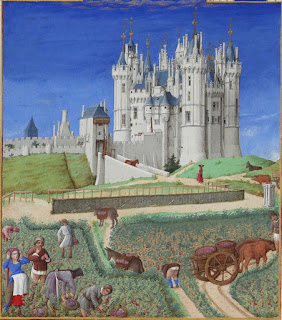
Castle of the Duc de Berry by the Limbourg Bros (15th c.)
Sometimes I wonder if I am, in reality, a tax-serf and this point in history marks the beginning of neo-feudalism or techno-feudalism. 

There is an idea that has emerged in recent years which holds that Western nations are increasingly dominated by billionaire elites and multinational corporations who seek to transform our nations into authoritarian surveillance states, wherein censorship is widespread and widely tolerated, real property is so hideously expensive that large portions of the population never even try to acquire it, and so many people live in what feels like a profaned world devoid of spiritual aspiration that nihilism is commonplace. On the other hand, a smorgasbord of transitory pleasures (junk food, online games, porn, prescription meds, etc) is perpetually within reach. Perhaps Tacitus’ observations about the actions of the Governor of Roman Britain in the 1st century CE are germane:
“Agricola … described his campaign … as ‘keeping a conquered people under control’ … His intention was … [that the native Britons] become accustomed to peace and quiet by the provisions of amenities. Hence he gave … assistance to communities to build temples, market-places, and town houses. He praised those that responded promptly [to Romanisation] and censured the dilatory. As a result they began to compete with one another for his approval, instead of having to be compelled … even our style of dress came into favour and the toga was everywhere to be seen. Gradually, too, they went astray into the allurements of evil ways, colonnades and warm baths and elegant banquets. The Britons … called it ‘civilisation’, although it was a part of their enslavement [Tacitus, Agricola and Germany, Oxford World’s Classics, Ch 18-21].”
Could it be that we are at risk of succumbing to the illusion of good living while in fact being profoundly unfree? In order to explore the possible answer to this question one first needs to understand what bondage actually is, hence the following exploration of some forms of servitude that have historically existed within European societies

28 November 2021

The Virus – A Pagan Sci-Fi

(A fictional short story inspired by the Australian lockdowns of 2021)
Statue of Mercury at Pavlovsk Park
Image by Aleksandrov (Wikimedia Commons)

The television turned itself on because it was time to get up. She lay in bed half-listening to journalists speaking in serious tones about various things, none of it was any more consequential than the faint sound of cars swooshing past on the road near her apartment until the voice of one man said sternly “what’s wrong with mandatory vaccinations?” Two men spoke to each other on the telly, one was a union leader complaining about activists hijacking a protest that had happened the day before – he explained that it wasn’t the case that workers were protesting against their own union for not pushing back against a government mandate that all tradies be vaccinated. What had actually happened was protestors had turned up and impersonated tradies … even so, the official union position was to support choice. The journalist on the State-run morning show chided the union boss for suggesting that adults should have the right to choose whether or not to be vaccinated.